Scientists are testing a surprising approach to fighting hunger in one of the poorest places on Earth
The following article is taken from Vox.com, with full credits to the author, Benji Jones.
To read the original article in English, click here.
Tsindrio eto raha te hamaky ity lahatsoratra ity amin’ny teny Malagasy.
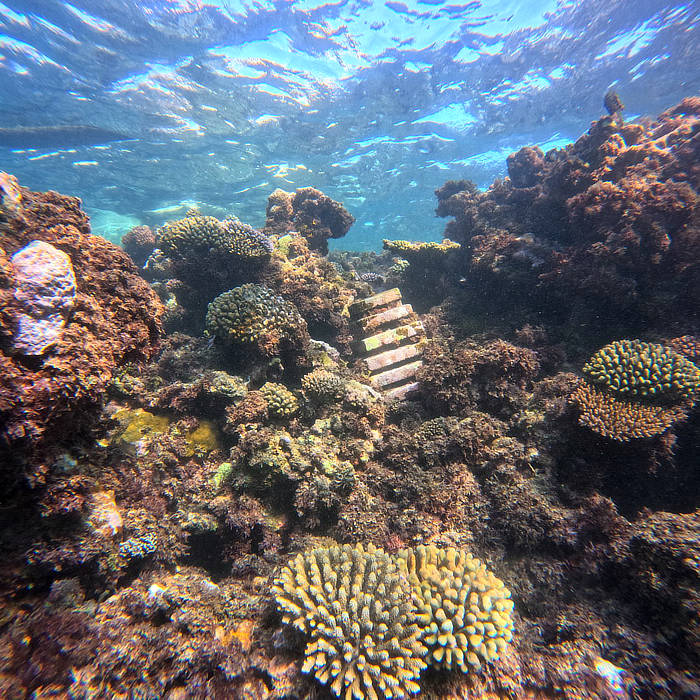
BAY OF RANOBE, Madagascar — The coral reef itself was exquisite. Growing about 3 miles offshore in 50 feet of water, it was a rugged terrain of pinks, blues, and oranges, set against a backdrop of deep blue. The coral pieces, each a colony of living animals, took on a range of unusual forms, from cake platters and pencil shavings to antlers and brains.
But there was one obvious thing missing: fish. Like a city without people, the reef was mostly empty — not only of fish, but also of crabs, eels, and other typical marine life on a coral reef.
It was a sunny morning in September, and I was diving on a coral reef in southwest Madagascar, an island nation that sits east of continental Africa. And like many reefs in the region and across much of the world, it’s on the verge of collapse. Overfishing has emptied the ocean here of fish, which over time will allow algae to take over and outcompete the corals. The increasing intensity of marine heat waves and cyclones, along with inland deforestation, also threatens the country’s reefs, which are among the most biologically diverse in the world.
This is a major problem for people along the coast of southwest Madagascar. Their livelihood depends on fishing — catching marine critters is an essential, and often the only, source of food and income — yet as the reef collapses, so does the fishery. The reef is where fish sleep, eat, and hide from predators, and without it, they struggle to survive. It’s a complicated situation: The health and well-being of people along the coast depends on fishing, yet too much fishing is a key reason why the reef, and the fishery it supports, is in decline.
This tension between human and wildlife survival is not unique to the coasts of southwest Madagascar. The island, home to about 33 million people, is among the poorest of poor nations, with some 80 percent of its population living on less than the equivalent of $2.15 a day. People often have no choice but to depend directly on ecosystems to meet their basic needs.
The government, meanwhile, has failed to provide even the most basic services like reliable electricity and water, let alone a pathway out of poverty and dependency on exploitation. That failure fueled weeks of youth-led protests this fall in Madagascar, where the median age is around 20. In response, Parliament impeached the president on October 14 and the military seized control of the government. What that power shift means for Madagascar, and for a generation demanding change, remains unclear.
Under the sheer weight of human need, it’s no surprise, then, that many of the country’s iconic ecosystems are failing, too. Research suggests that since the turn of the century the country has lost as much as half of its live coral cover, and a similar extent of native forest. Nearly every species of lemur, a type of animal that you can only find in Madagascar, is now threatened with extinction.
The government and nonprofit groups have spent decades — and hundreds of millions of dollars in foreign aid — trying to address these challenges, often relying on traditional environmental approaches, like setting up reserves that restrict fishing. But what Madagascar shows is that conservation projects don’t usually work when they make it harder for desperately poor people to make a living. That may seem obvious, but it’s one reason why many environmental projects have failed in the world’s biodiversity hotspots, which are commonly found in poor nations.
Places like Madagascar underscore the need for a different conservation approach — one that truly centers people, and what they need to live healthy and fulfilling lives. That’s what ultimately brought me to the Bay of Ranobe, where I spent a week in September. Guided by fishers and a team of international researchers, a small organization is trying to restore the fishery and the food it provides, without actually restricting fishing. The goal of the project is to help people. Conservation is just a byproduct.
The ocean was calm and flecked with sails when I arrived one morning at the beach in Ambolimailaky, a fishing village in the Bay of Ranobe. The sails — often made of discarded rice bags stitched together — propelled fishermen to shore in wooden canoes known as pirogues.
As the fishermen neared the beach, I saw jumbles of mosquito nets in some of their boats. In Madagascar and elsewhere in Africa, it’s not uncommon for fishermen to repurpose mosquito nets — which are often donated by aid organizations to protect against malaria — to catch fish.
The fishermen showed me what they caught. Some of them had buckets of small anchovies that moved like liquid silver. Others had a bin filled up halfway with reef fish like triggerfish, lionfish, parrotfish, and baby barracudas. A group of young kids put a few that were still alive, including a clownfish, into a metal bowl to play with. A pair of school-age boys showed me a plastic bucket with a dozen juvenile octopuses they caught. The tentacles were tangled together and partially submerged in ink.
As someone from the US who doesn’t fish, I felt unsettled in the face of so many dead and dying creatures. I normally encounter reef fish and octopuses in aquariums, on snorkel trips, or in the marketing materials for conservation groups. But fishermen here have a different relationship with them — and for a very good reason.
In the Bay of Ranobe, fishing is the primary source of income and a vital source of nutrition in coastal villages, according to Aroniaina “Aro” Manampitahiana Falinirina, a doctoral researcher who studies fisheries at the University of Toliara’s marine research institute, IHSM. It’s how people pay for food, school supplies, and transportation. And among certain communities — namely, the Vezo, an ethnic group with deep ancestral ties to the sea — fishing has been a way of life for generations.
Speaking through an interpreter, Nambokely, one of the fishermen I met on the beach, told me that if he doesn’t fish, he doesn’t eat.
Fishermen in the Bay of Ranobe work around the clock to support their families.
One evening, just after the sun had slipped below the horizon, I boated out on the water with a few researchers who study coral reefs and fisheries. The ocean’s surface was full of bioluminescent microorganisms that lit up as the bow of our skiff cut through the waves. It was as if we were riding on fairy dust.
But the main light show was underwater. Once we were farther offshore, beams of light appeared below the waves, moving erratically in all directions — night fishermen. The fishermen spot their prey using waterproof torches, sometimes made by wrapping ordinary flashlights in a few condoms.
After surfacing with an eel on his spear, one fisherman, a Vezo man named Jean Batiste, told me he fishes at night because he can catch more compared to during the day.
Yet as Batiste said — and as every fisher I spoke to in the Bay of Ranobe repeated — it’s becoming harder and harder to catch anything, and thus harder and harder to earn a living. “I’m worried,” Batiste told me that night on the water.
The fishery in the Bay of Ranobe, and across much of southwest Madagascar, is in decline, and perhaps even collapsing. A number of studies from the region show that fishermen are catching fewer fish, and fewer fish species, compared to three or four decades ago. Some species — including certain kinds of parrotfish, which can help limit the growth of coral-harming algae — have disappeared altogether from some areas. “It’s decreasing at a rate that has never been seen before,” said Gildas Todinanahary, a marine researcher and the director of IHSM.
The fish people are catching are also smaller, indicating that fishermen may be netting more juveniles — a clear sign of overfishing. If the adults and the juveniles are fished out, there’s nothing left to spawn the next generation.
“People can’t get enough food in one day.”— Marcel Sebastian
A single fisherman was once able to earn, on a good day, around $10 or $15 in one outing, Nambokely told me. But today, groups of four or five fishermen will spend several hours on the water and might only catch enough to fill half a plastic wash basin with fish. That’s worth about $5 to $10, they told me, which they then have to split among themselves. A dozen small octopuses, meanwhile, are worth only around $2.
“People can’t get enough food in one day,” said Marcel Sebastian, an elderly fisherman I met in the village. He’s been fishing in southwest Madagascar for more than 50 years. “They used to have lunch and dinner. But now they only have dinner due to the scarcity of fish.”
The problem isn’t fishing. It’s overfishing — the forces that ramp up fishing to such an extreme that the reef and the life it supports have no time to recover. That’s what’s happening now in southwest Madagascar. There are simply too many people fishing for the same fish.
One reason for that is climate change. Rising temperatures are contributing to prolonged droughts that make it harder to grow crops in southern Madagascar. Meanwhile, widespread deforestation — which removes trees that stabilize the soil and help water seep underground — means that when it does rain, flooding can bury farmland under sediment. Faced with failing crops inland, farmers in southern Madagascar are increasingly migrating to the coasts in search of income from fishing instead. (Inland deforestation is also sending dirt into the ocean, which can smother coral reefs.)
This climate-driven migration is causing the coastal population to swell, putting pressure on the fishery. It’s hard to find reliable population estimates for the Bay of Ranobe, but a dissertation from 2019 estimated that villages here were growing at an average rate of about 4.5 percent per year, meaning the local population would roughly double in 15 years. The global average population growth rate is around 1 percent. “A lot of the time, people who are coming from inland don’t want to be here,” said Quinn Mitsuko Parker, a doctoral researcher at Stanford who studies fishing communities in the Bay of Ranobe. “They don’t want to be fishing. They’d rather be farming.”
But people have no choice but to fish. Even though it’s no longer providing enough. Even though it’s hastening the decline of the reef and the source of income it provides.
One morning, around the new moon, I went out on the water with a few fishermen at low tide. The water got deeper at first, but as we motored farther out, it became shallow again — until it was so shallow we could walk. We were on top of the barrier reef. It was a bizarre image: Here we were, in what felt like the middle of the ocean, standing in just a few inches of water.
During especially low tides, part of the reef here is exposed, and fishers — in this case, mainly women — take advantage of these conditions. They search the reef by foot for octopuses, urchins, and other critters to eat or sell, an approach known as gleaning.
At least a dozen women were gleaning when we arrived, their eyes fixed downward as they paced around. Some of them wielded spears, to stab octopuses, or large conch-like snail shells, which they use to crack open urchins.
I approached a woman named Doseline, who wore mismatched sneakers and a wide-brimmed hat. As we talked, she poked a spear under rocks in search of octopuses, occasionally pausing to grab a snail and put it in her bag.
Doseline told me she’s catching half as many octopuses as she did 10 or 20 years ago. And while she knows gleaning can damage the coral — most of the exposed reef is already dead, in part because fishers sometimes crush corals under their feet or break them to grab hiding octopuses — she doesn’t have a choice, she said. Doseline is the sole provider for her son, who’s in school, she said. “My income [from fishing] is not enough,” she told me.
For more than an hour, I watched Doseline search the reef. We stepped over spiny red sea stars and a colorful slug called a nudibranch. I found discarded shells occupied by crabs that looked like creatures from another world. Doseline, who wore her hair in pigtails, didn’t have much luck. “I’m sad because I didn’t catch any octopuses, so I’ll go back home,” she told me.
Over the last three decades, Madagascar has attracted an enormous amount of attention from international environmental groups and foreign donors. The island’s wildlife is not only charismatic — lemurs! chameleons! coral reefs! — but also unique. Because Madagascar has been isolated from other land masses for millions of years, animals there have had plenty of time to evolve into new species. Today, around 90 percent of the country’s plants and animals are found nowhere else on Earth. That means if you lose them in Madagascar, you lose them everywhere.
With so much to lose, major international environmental groups ranging from Conservation International to WWF have been working for years on the island to try to curb forest loss, overfishing, and other kinds of environmental harm. And aid organizations have funneled hundreds of millions of dollars into Madagascar to help. Yet those threats are still getting worse, not better.
The main problem is poverty — the sheer demand put on the environment — which is closely linked to political unrest. But there are also serious problems with the traditional approach to conservation in Madagascar and other developing nations.
Historically, environmental groups, foreign scientists, and the government in Madagascar bet big on protected areas as a means to safeguard nature, such as parks, marine protected areas, and nature reserves. The Bay of Ranobe is, for example, technically part of an official marine protected area. But as research shows, those protection schemes have done little to stop environmental harm.
“The conservation of our biodiversity through Madagascar protected areas’ system for 30 years was a failure,” Madagascar’s former environmental minister, Baomiavotse Vahinala Raharinirina, said in 2020.
According to several environmental and development researchers I spoke to, that’s because parks often don’t address the reasons why people exploit nature in the first place. In some cases, they also disproportionately burden women fishers by restricting access to areas for gleaning, as Merrill Baker-Médard wrote in her book, Feminist Conservation: Politics and Power in Madagascar’s Marine Commons.
Another challenge is that NGOs in Madagascar, and to an extent worldwide, are often more accountable to their donors than they are to the local community, according to Emma Gibbons, who runs Reef Doctor, a small nonprofit in the Bay of Ranobe. Donors tend to fund short-term projects and they face few consequences if projects don’t actually help people or ecosystems, Gibbons said. These issues are especially pronounced in southern Madagascar, nicknamed the “cemetery of projects,” because so many of those projects — from establishing solar water pumps to beekeeping — have failed.
If there’s a chance of conservation working, it has to be owned or guided by the community, rooted in a deep understanding of the local culture, and aligned with what people want, said Gibbons, a British national who’s lived in Madagascar for two decades. Fishermen here certainly want to safeguard the fishery — it’s their livelihood, their survival — but they can’t afford to lose their fishing grounds in the process. Food security takes priority. “You can’t tell people not to eat,” Gibbons said.
It’s this perspective that’s informed the approach Gibbons is taking now. Instead of attempting to limit fishing as some traditional conservation has tried to do, she — along with members of the community and a team of local and foreign researchers — are trying to create more places to fish.
To do that, they’re essentially building new coral reefs from scratch in the Bay of Ranobe.
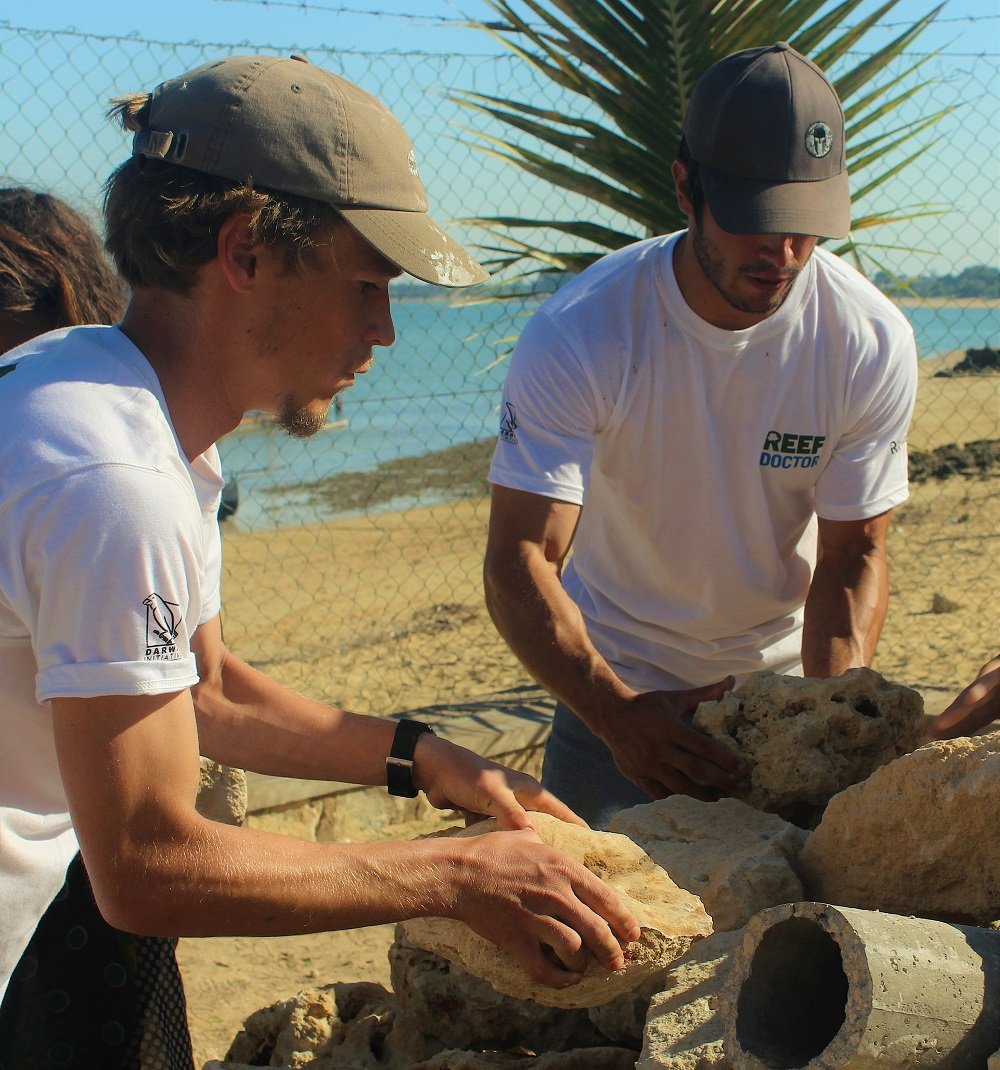
Building artificial reefs is simpler than it sounds: She and her collaborators sink massive chunks of limestone offshore, forming long underwater rows of rocks that are each about 57 meters. That’s roughly the length of a commercial airplane. They then “seed” those rocks with life using smaller constructions called autonomous reef monitoring structures (ARMS) that have spent several months accumulating corals, sponges, and other marine organisms on a natural reef. Those structures, made of stacked stone plates, are basically coral reef starter packs.
So far, Reef Doctor has finished building two artificial reefs that cover about half an acre. Each of them has four rows of rocks, known as spurs, seeded with ARMS. “Our hope is that we can increase the area that’s available to fish,” Gibbons said.
The sea was calm and more green than blue when I arrived by boat above one of the artificial reefs, about a mile from shore, with marine biologist Mark Little. He’s studying microbes on the reef. The water was cloudy, so we could barely see the rocks below — not the most inviting conditions. But we strapped on tanks and plunged in.
As I sank down, the rows of rocks appeared dramatically through my foggy mask, as if I was descending on ruins of a lost city.
I swam up to a group of ARMS, from which fist-sized bits of coral sprouted like branches of a bonsai tree. Box fish, lionfish, and even young parrotfish — named for their bird-like beaks — crowded around them. At one point, a stingray appeared out of the murky beyond and passed right in front of me, before vanishing again. I was struck at that moment by the realization that we’ve damaged our environment so badly that we literally have to rebuild ecosystems we depend on from scratch. At least in this case, that approach seems to be working.
“It’s doing its job,” said Little, a postdoctoral researcher at Harvard University and Scripps Institute of Oceanography, when we were back in the boat. “There’s a lot of life.”
Early surveys of the artificial reef have detected hundreds of animals across tens of species, including giant clams and cone snails, according to Aaron Hartmann, an ecologist at the US-based Perry Institute for Marine Science, who’s closely involved in the project.
Over the next several years, a team of local and foreign researchers will study the impact of the artificial reefs on marine life and the fishery here — and how that, in turn, affects the physical and mental health of people in nearby villages. The study is among the largest in the world to link ecosystem health to human health, according to Chris Golden, a nutrition and global health researcher at the Harvard TH Chan School of Public Health, who’s closely involved in the project.
The purpose of this study is “to understand whether or not stewarding natural resources in this way can simultaneously benefit the ecosystem and benefit human nutrition and food security and human health,” Golden said. “We want to quantify the way that interventions like this — an environmental intervention — could be viewed as a public health intervention.”
I can’t help but feel like it’s just nowhere near enough. If the scale of fishing continues — or increases, as the coastal population swells — a few artificial reefs won’t be able to rescue the fishery. Even scientists involved in the project understand the limitations. “Within the broader situation, it’s not going to work,” said Todinanahary, who works closely with Gibbons.
Truly sustaining the reef and the fishery means providing coastal communities with other sources of income, Todinanahary told me. That means investing in education so people can learn new skills, like climate-resilient farming, and building out other non-exploitative industries. The country needs enormous, systemic change for conservation to really work. That requires good governance, and right now Madagascar hardly has a government.
But as Todinanahary points out, NGOs and aid groups have poured millions of dollars into Madagascar for environmental projects. What if those groups had, instead, put all of that money toward education or health care? Sometimes, effective conservation doesn’t look like conservation at all.
Ultimately, what I saw in the Bay of Ranobe was more bleak than I had imagined. At times, it felt like watching an environmental and human crisis unfold in real time. Nonetheless, people like Gibbons, Todinanahary, and a growing number of smart Malagasy scientists are still determined to restore the fishery — because the stakes are just so high. When you’re actually a part of these communities, you’re accountable to them. That makes the consequences of doing nothing hard to stomach.
And it’s far from futile. The reef, and the fishery it supports, could still recover. There’s still life.
After diving on the artificial reef, Little and I boated to a natural reef nearby, called Vatosoa. Several years ago, Reef Doctor built a smaller artificial reef close to Vatosoa for people to fish on, and in exchange, local fishermen agreed to avoid this one, Gibbons told me.
My expectations were still low, especially after diving reefs here that had no fish. But it was spectacular. The reef was formed by a species that grows thin, curved sheets of coral in layers around each other, like petals of a rose. And there were dozens of these living structures packed in together, so it felt like we were swimming over a bouquet.
My mask kept fogging up, a deeply irritating problem that can ruin a dive. I flooded it with seawater and cleared it with bubbles a handful of times. When I could finally see clearly again, I noticed something floating in front of my face. It looked like a piece of seaweed, though it was attached to the unmistakable body of a cuttlefish, a cephalopod with eight arms and two tentacles.
Famous for its camouflage, the animal seemed to be using its arms to mimic a piece of debris. As I swam toward it, the cuttlefish reversed slowly. Moments later, perhaps after realizing it was not fooling me, it changed colors and sped off.
“The potential for recovery is still there,” Gibbons told me one evening, as we walked the beach at sunset, careful to avoid stepping on discarded spiny shells. “There’s huge biodiversity within the fishery. It’s not going to be there forever, but it’s still, at this moment, there.”
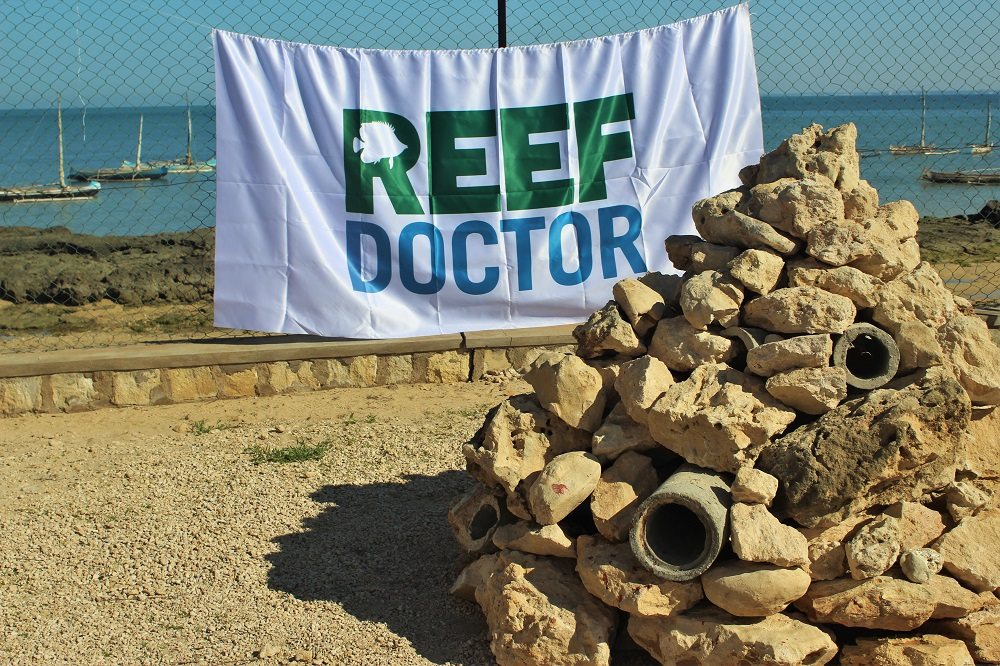
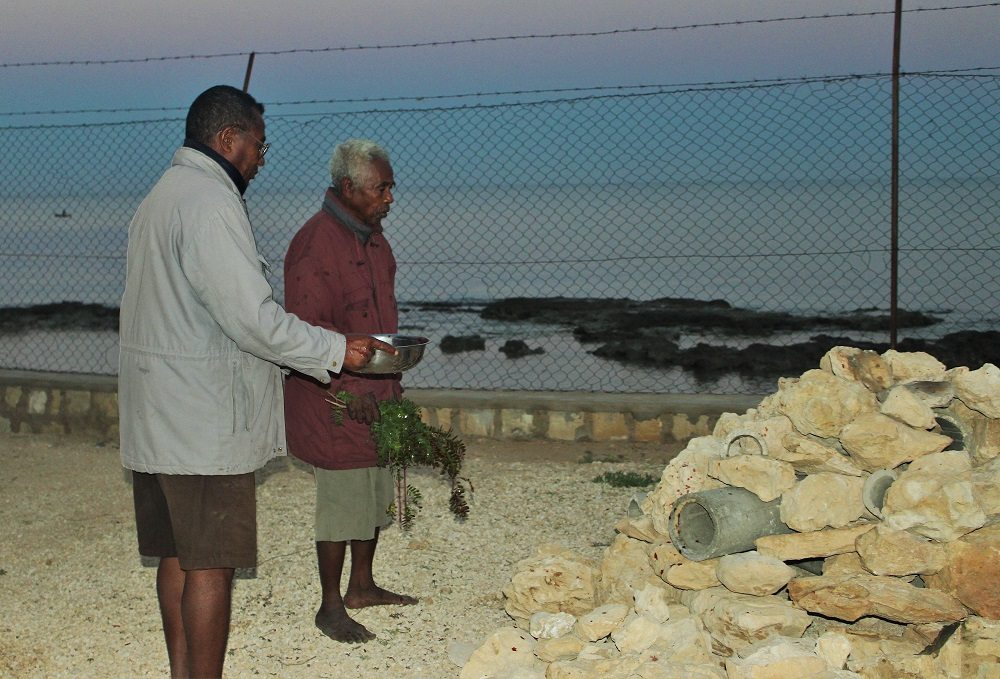
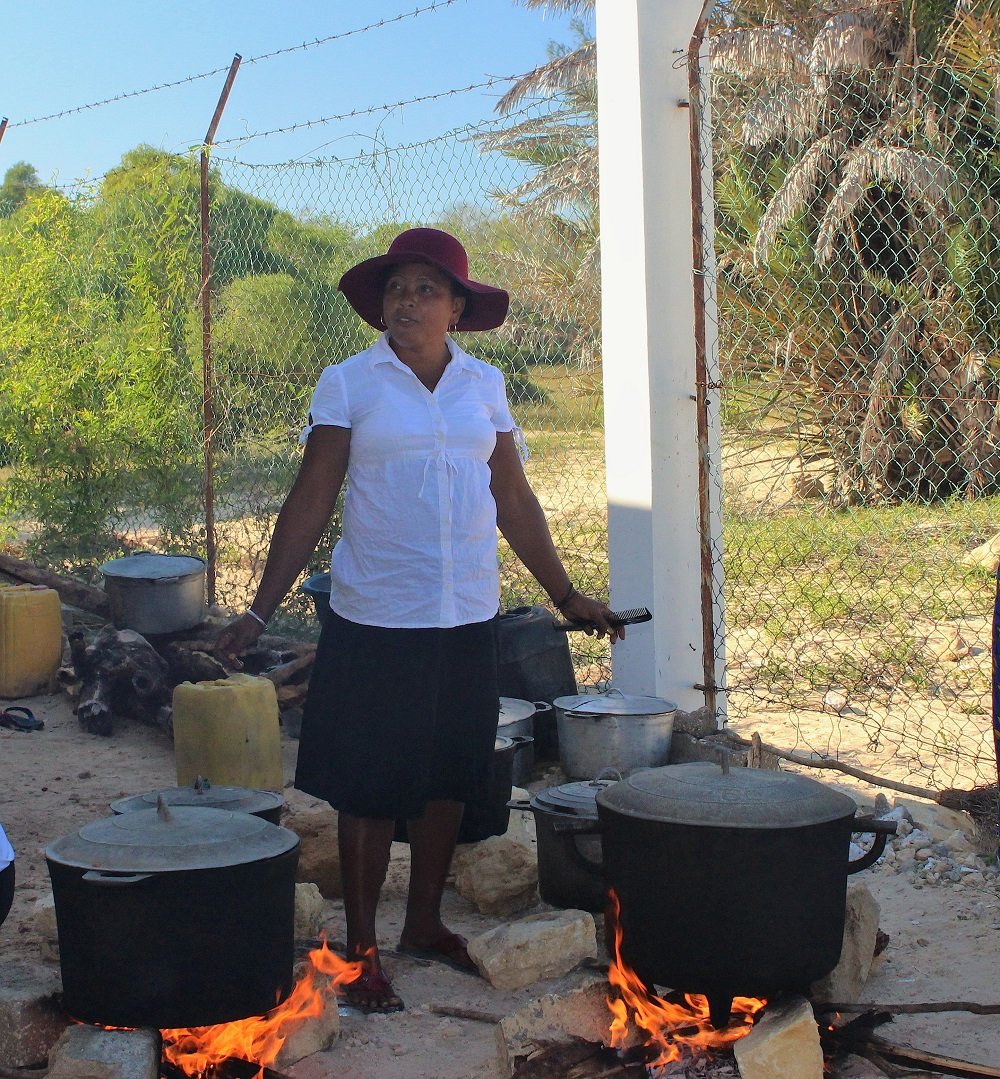
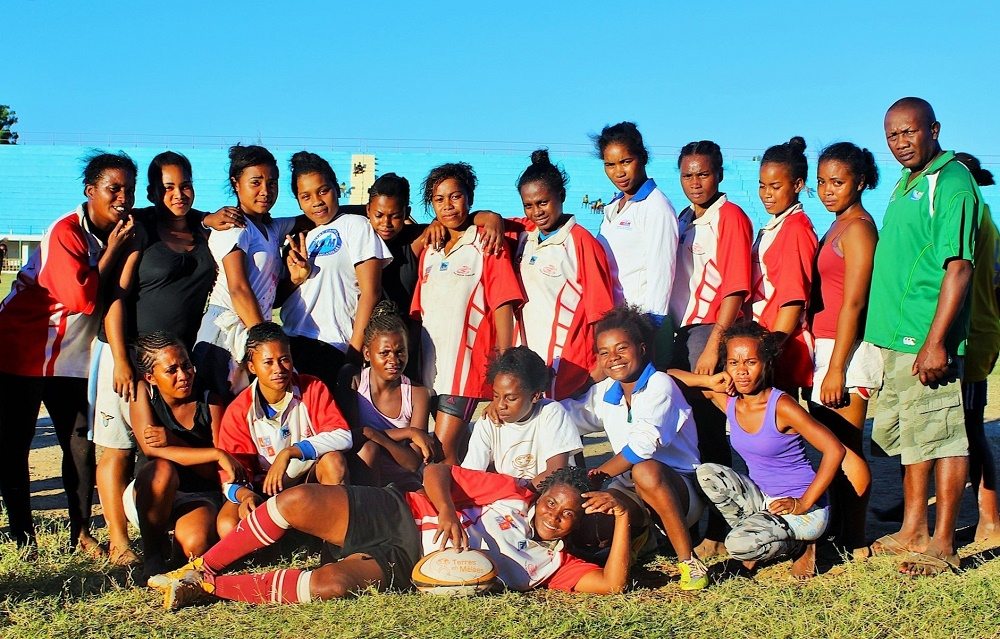
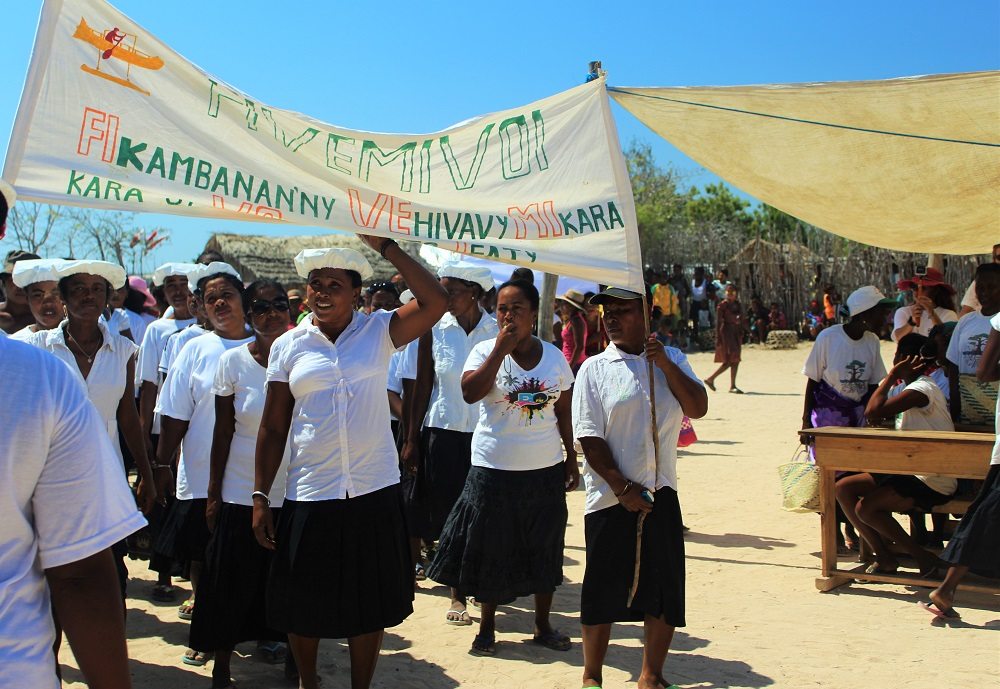
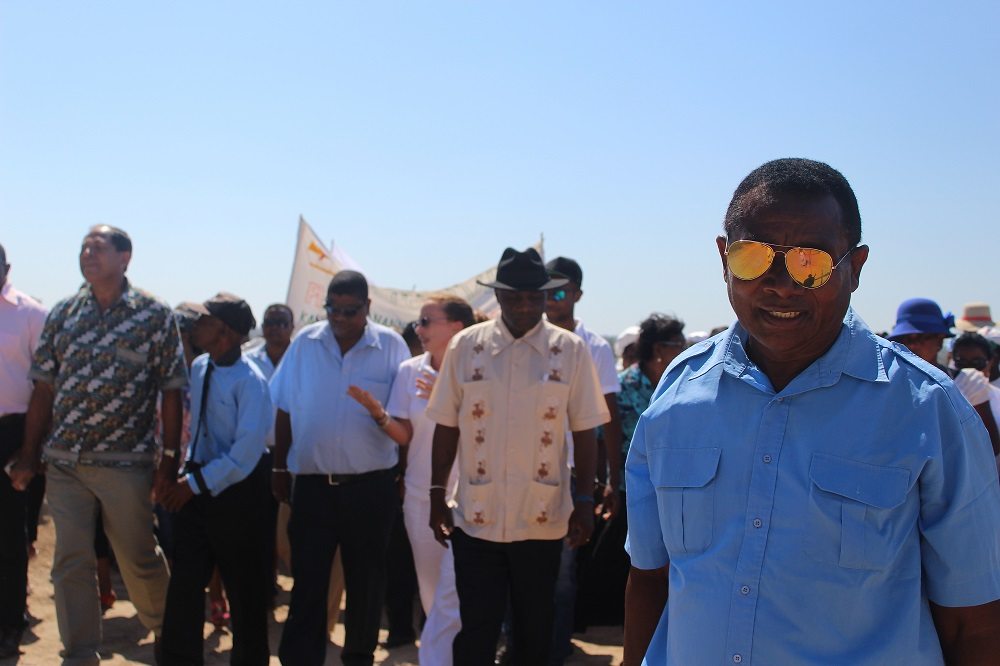
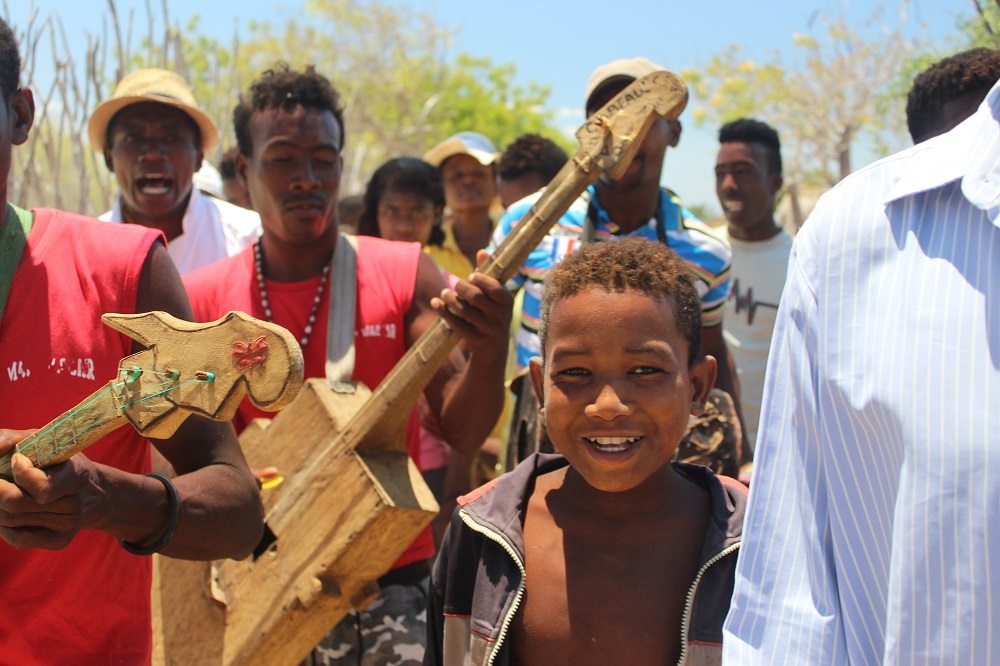
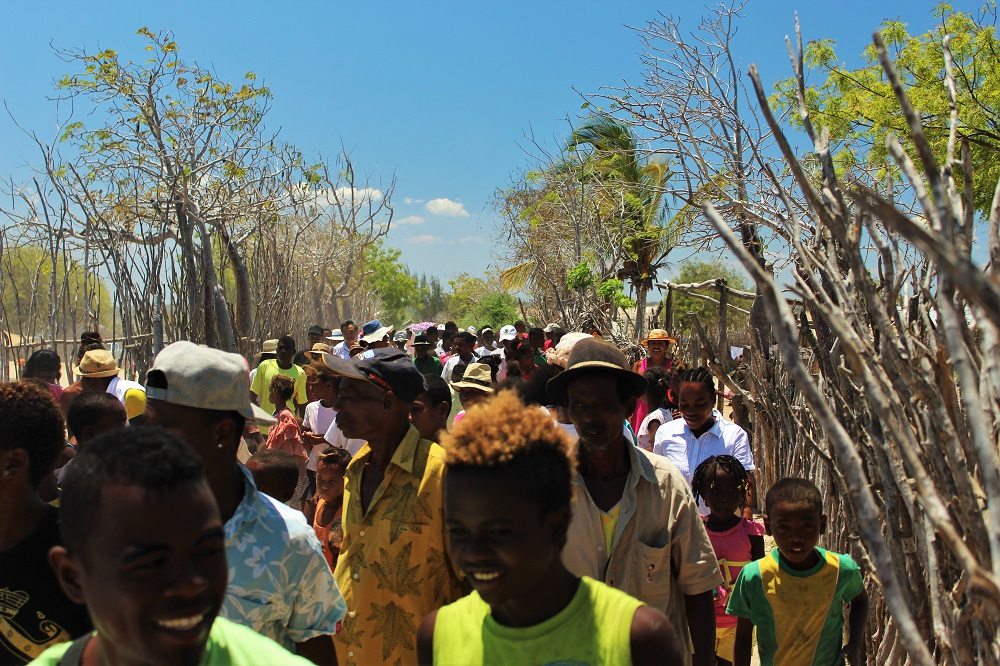
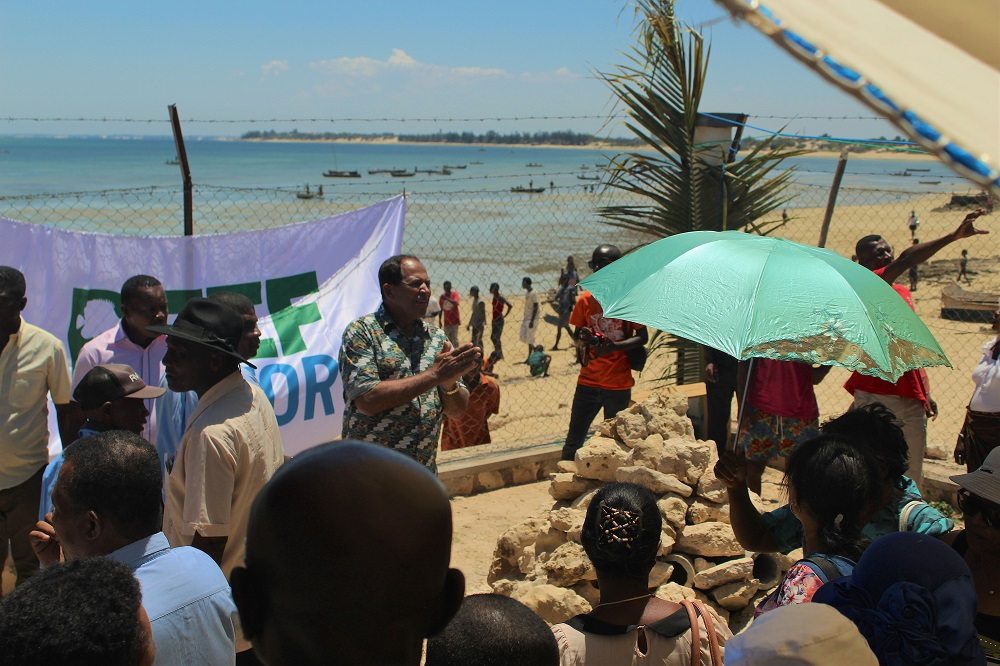
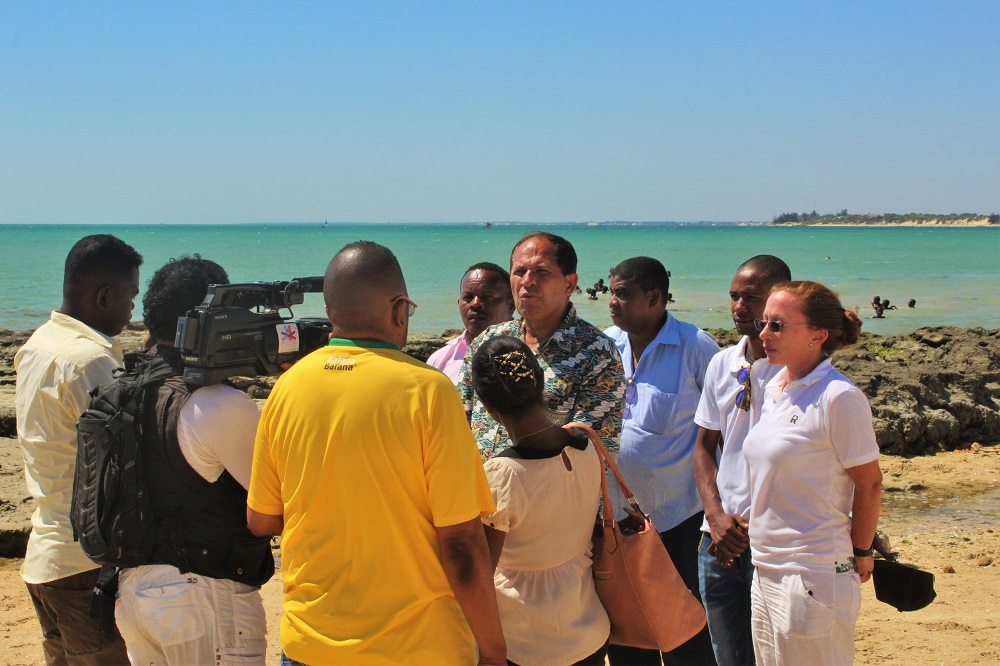
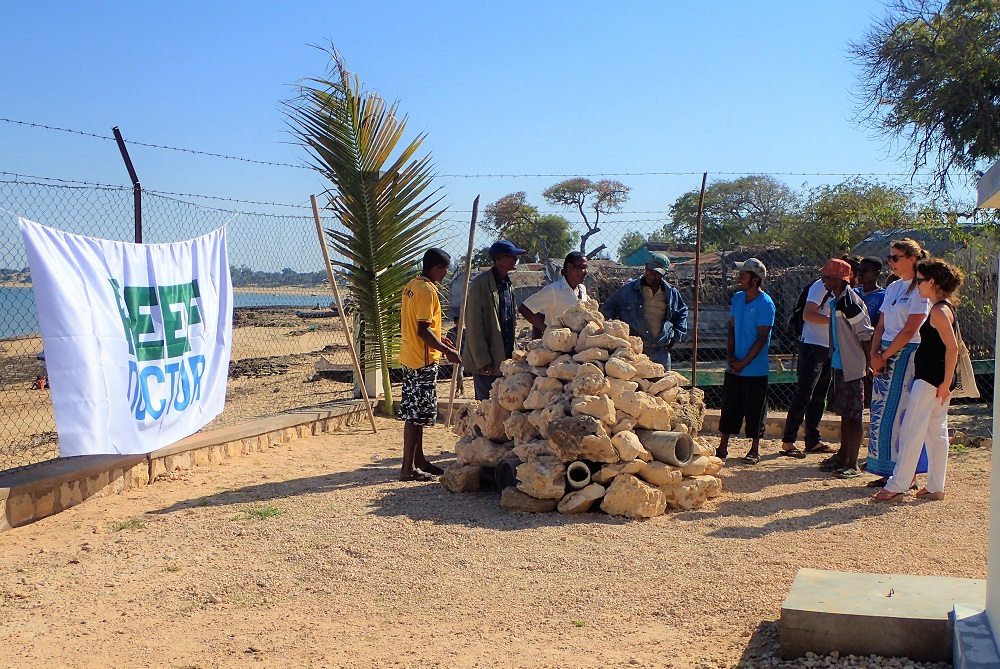
 By 9am everything was ready and the officials, Monsieur Francois Gilbert, Minister of Fisheries Resources and the Mayor of Belalanda region among them arrived in style together with a national news crew and Emma Gibbons, Director of ReefDoctor. We met their procession just outside the village and the crowd including Ifaty women’s rugby team, the women’s association and a band danced and sang their way to the school where the officials took seats to enjoy some entertainment from local women’s groups from Ifaty (yes these ladies can multi task!), Ambondrolava, Tsivonoe and Mangily. Between groups a band of traditional dancers entertained the crowd. And speeches were given looking forward to the growth of the reef and the future of the Debarcadere.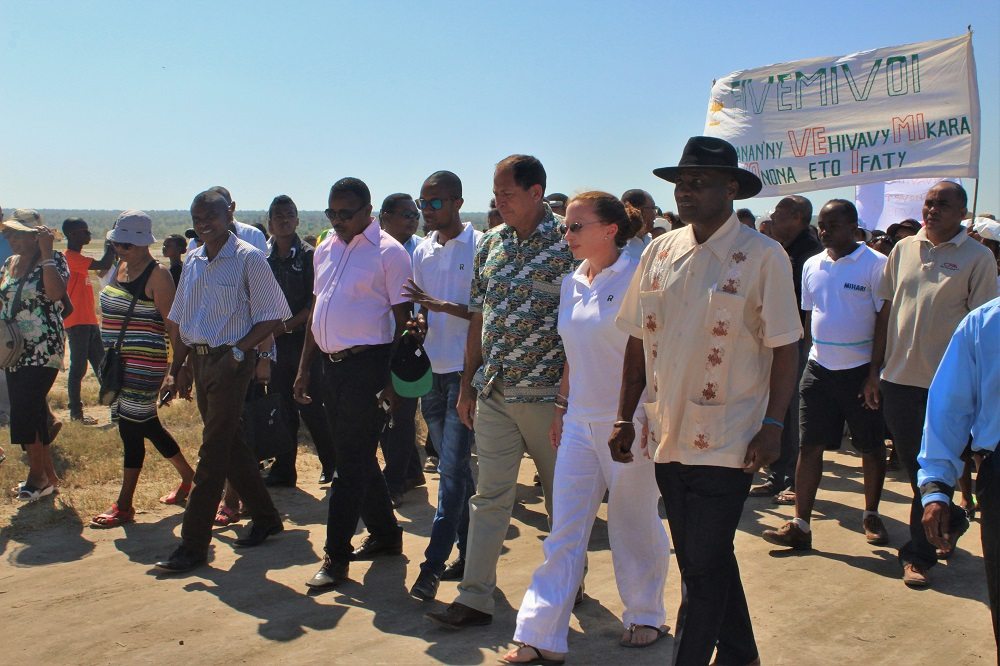
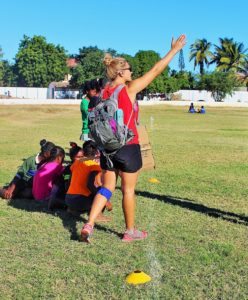 e Ifaty women’s rugby team as they have practiced for a sevens friendly against the women’s team from Tulear. Before I came to Reef Doctor, I was very excited to learn that rugby – especially women’s rugby – had a presence in Madagascar; however, I did not realize what an understatement that is. Rugby is Madagascar’s national sport, and has built a fanatic following among the Malagasy people; even our daily practices regularly drew a crowd from the village. This environment is markedly different than where I learned how to play rugby, in St Andrews, Scotland, where our league games would draw crowds of about 10 people (and we even won the league one year!). However, general enthusiasm, for women’s sports as well as men’s, is only one of the many differences I noticed. On that note, here’s a bit on rugby, Gasy style.
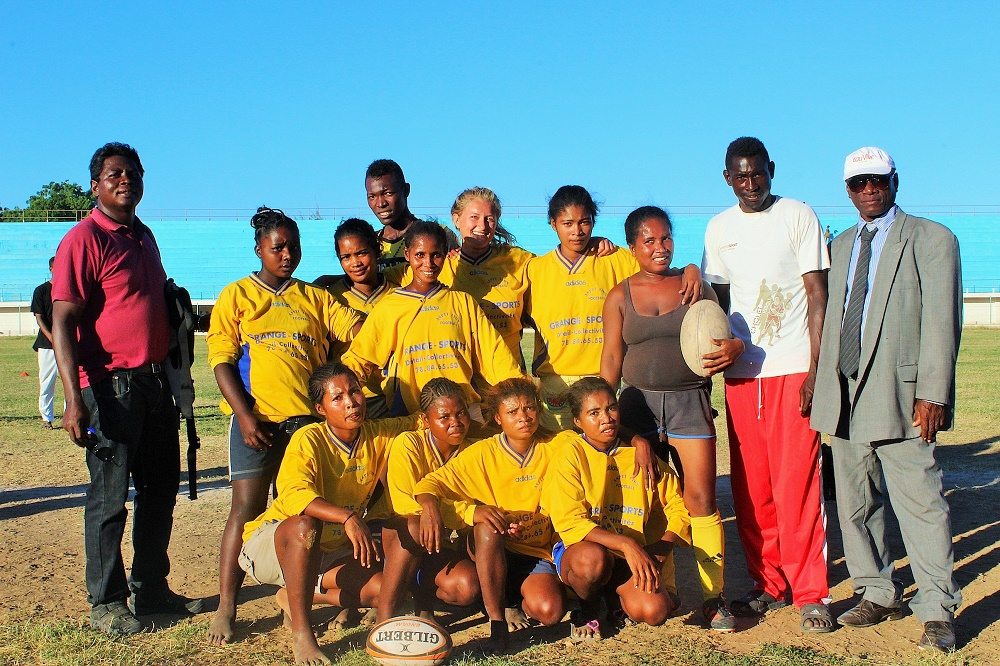 The Ifaty team plays on the local football field, which consists of sand, little rocks, bigger rocks, rock substrate underneath a centimeter of sand, and the occasional spike or ten. Practice starts when Coach Elias makes his way to the field, blowing his whistle incessantly throughout the village. The girls come in whatever they own: jean shorts, dresses, skirts, bathing suits, often with necklaces, earrings, and very long nails. Many of the things we take for granted in the West simply aren’t present here: there is a distinct lack of water, first aid, nail clippers, mouth guards, shoes, sports bras, and game kit. During games, the Ifaty team wears the jerseys of the men’s football team; if they want to wear shoes, they must borrow them from another team or go without. However, what they lack in kit, they make up for with determination. As far as how the game
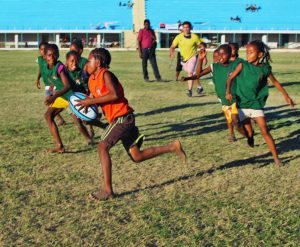 is played, when these girls hit the pitch, it is with no holds barred. There is no such thing as “touch” here; it’s full contact all the time. This tradition is telling of rugby’s history in Madagascar; the game is especially popular in the Tanàna Ambany (low villages) of Antananarivo (Tana), the location of the capital’s poorest inhabitants, as well as the highest rates of illiteracy and idleness. Although rugby in Madagascar is played by the upper class as well, French sociologist Pierre Bourdieu emphasized how especially important the sport is for the lower classes, which lack education and therefore job prospects (source: Razafison, 2010, Africa Review). In fact, many of the country’s rugby stars come from these low villages, and are then catapulted into the national spotlight. In many aspects, Ifaty’s situation is similar to the low villages of Tana, which is why it is so important to make sure the sport is able to thrive here.
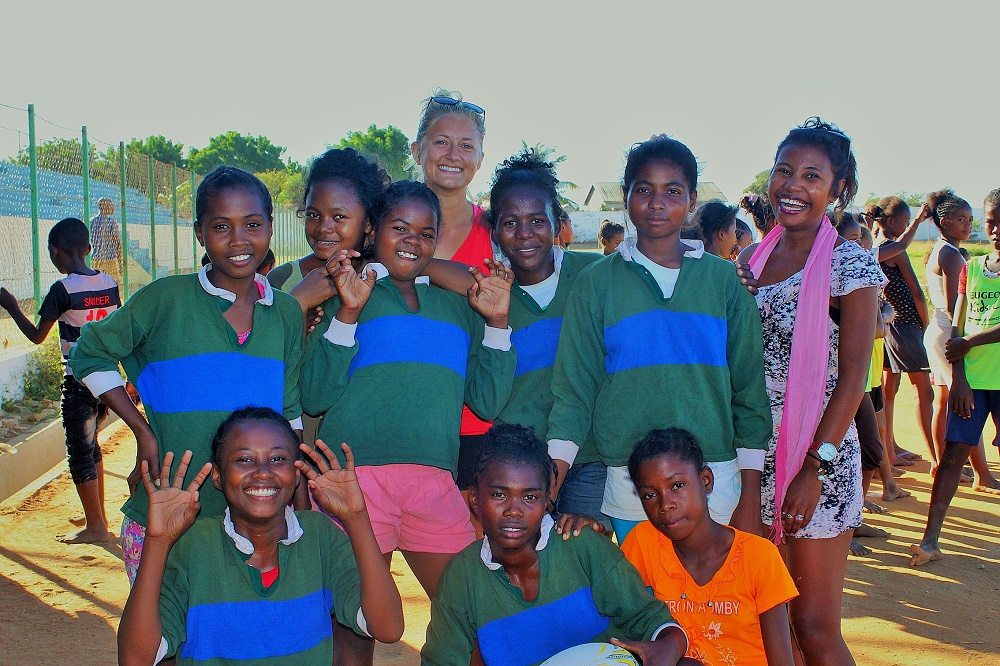
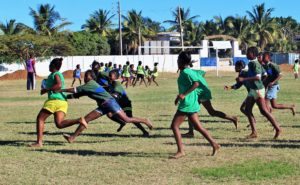 ing session of over 30 primary school teachers in alternative teaching and learning strategies. Approximately 320 girls from all over the Southwest region, including Salary Bay, Desakoa, Ifaty, Satrokala, as well as many girls from primary schools in Tulear, attended the tournament – even a local orphanage brought a team! The girls were split up into groups of 9-10 when they arrived, and all the adults present were given a team to coach throughout the day. (With this experience behind me, I can say that it is not easy to coach a team of Gasy girls with a limited comprehension of the language and no French skills.) The day itself was a blast, and all the girls got to make new friends and encounter different playing styles. In the afternoon, the women’s teams from Ifaty and Tulear played a match before the tournament finals. It was an excellent game, and both teams really left it all on the pitch. Although it was an extremely close game, the final score saw a 10-5 win for Tulear, giving the Ifaty girls all the more reason to practice hard in the coming months as Regionals approach.